WABSI is globally informed, locally relevant and end user led
Our 10-year vision, as set out in the WABSI Strategic Plan 2022-2032, demonstrates our commitment to being end user led and to respond to emerging issues and key biodiversity science questions.
We undertake structured end user engagement on a regular basis with industry, government, regulators, science researchers and the community. The consultation unpacks complex, current and emerging issues and identifies priority biodiversity science knowledge gaps. The consultation findings are published periodically on the WABSI website and insights help shape targeted research programs which are co-developed with end users. The programs enable action-ready knowledge to inform smarter decisions and deliver stronger environmental outcomes.
Biodiversity knowledge priorities 2026
Structured end user engagement undertaken in late 2025, with a range of organisations, focused on identifying current and emerging issues faced by end users of biodiversity science. Major issues identified by end users included:
- Strategic and long-term bioregional planning for better conservation
- Ensuring food security and sustainability
- Transitioning to renewable sources of energy
- Information for decision-making
- Ensuring climate resilient ecosystems
- Understanding how to value biodiversity and impacts
The WABSI publication From knowledge to action: Western Australia’s biodiversity knowledge priorities provides more information.

List of stakeholders consulted
- Alcoa
- Association of Mining and Exploration Companies
- ANZ
- BHP
- Bush Heritage
- Department of Biodiversity Conservation and Attractions
- Department of Climate Change, Energy, the Environment and Water
- Department of Energy and Economic Diversification
- Department of Mines, Petroleum and Exploration
- Department of Primary Industries and Regional Development
- Department of Water and Environment Regulation
- Environment Institute of Australia and New Zealand
- Environmental Consultants Association
- Grower Group Alliance
- Heidelberg Cement
- Mineral Resources
- Minerals Council of Australia
- Newmont
- Northern Agricultural Catchments Council WA
- Perth NRM
- Rangelands NRM
- Responsible Investment Association of Australia
- Rio Tinto
- South Coast NRM
- South West NRM
- Urban Development Institute of Australia
- Western Australian Local Government Association
- Wheatbelt NRM
Biodiversity knowledge priorities 2022
In early 2022, WABSI undertook extensive consultation with more than 50 end users across industry, financial services organisations, government, conservation groups, non-profits, scientists and researchers. The consultation identified several emerging, strategic, biodiversity knowledge priorities – large, complex issues which can only be addressed through collaboration.
End user biodiversity knowledge priorities for the next decade
- Measuring biodiversity
- Carbon and biodiversity values
- Biodiversity data and cumulative impact
- Incorporating traditional knowledge and values into biodiversity conservation
- Restoration
- Climate adaption and resilience
- Mitigating the impact on biodiversity from key threats
- Urban forest and biodiversity
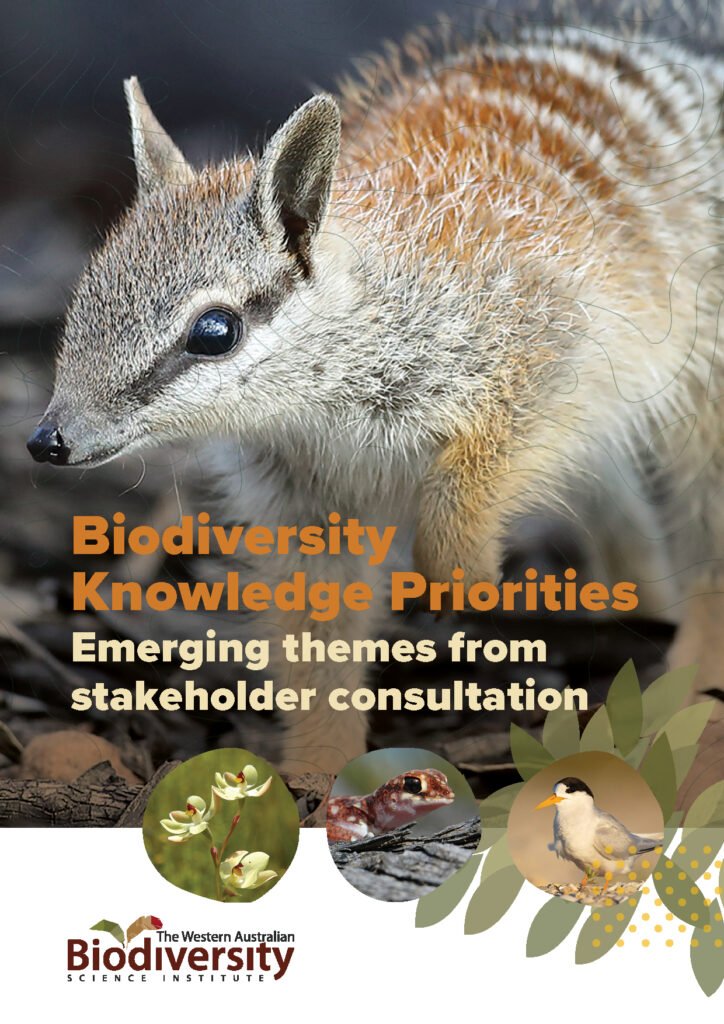
The WABSI publication Biodiversity Knowledge Priorities: Emerging themes from stakeholder consultation (link below) provides more information on the themes identified during the 2022 stakeholder consultation.