

Mitigating cat impacts.
Connecting end user needs with independent science to improve decisions about feral cat impacts, management effectiveness and native wildlife recovery.
Feral cats are a significant pressure on many native species, but management effectiveness varies across landscapes and contexts.
WABSI’s program starts with the needs of those making conservation and management decisions, identifying critical knowledge gaps and coordinating research to improve evidence about impacts, control and outcomes.
The challenge of feral cats.
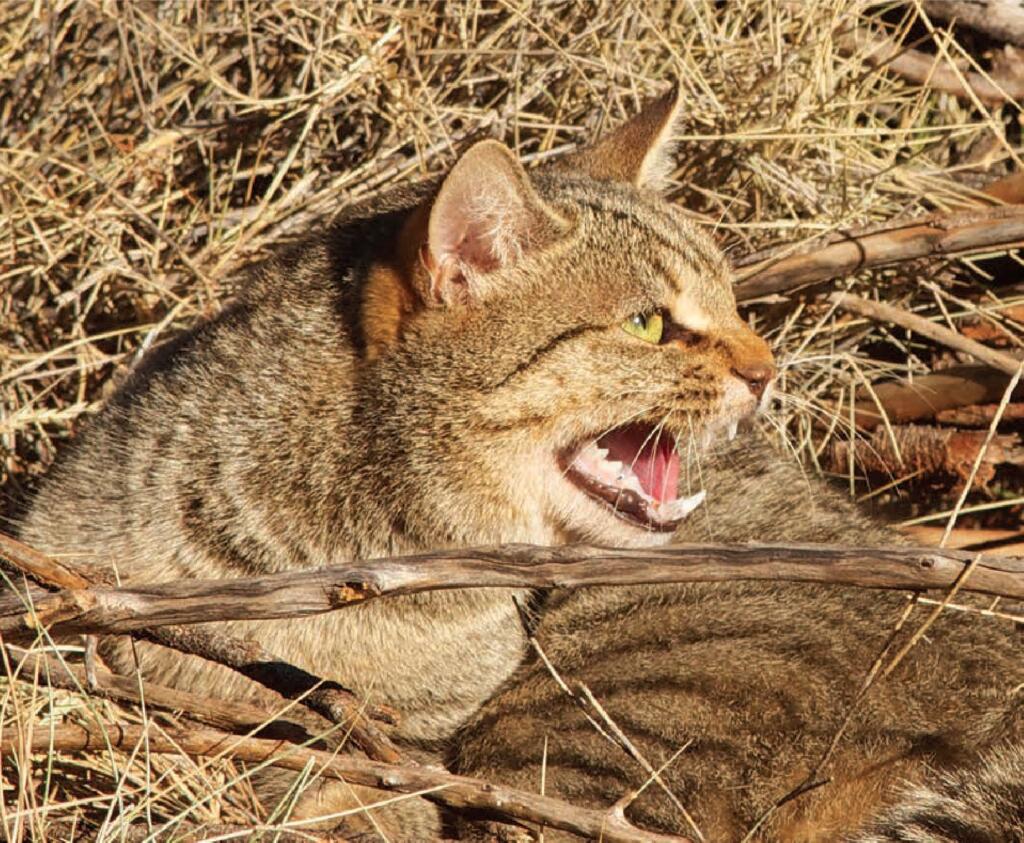
Feral cats occur across extensive and diverse Western Australian landscapes and can affect native mammals, birds, reptiles and other fauna.
Their impacts are influenced by habitat, prey availability, climate, predator behaviour and the vulnerability of native species.
Management is therefore complex: approaches that work in one context may not deliver the same outcomes elsewhere, and measuring population change or biodiversity response can be difficult.
Decision-makers need better evidence about where management should be prioritised, which interventions are likely to be effective, how success should be measured and how actions can be coordinated at landscape scale.
WABSI works with end users to define these questions, review existing evidence and identify critical gaps.
The resulting research program can address predator ecology, species vulnerability, monitoring, control effectiveness and biodiversity responses.
By connecting independent science with conservation practice and investment decisions, WABSI helps improve the targeting and evaluation of management effort and supports better outcomes for native wildlife.
Where the program concentrates its work.
-
Social licence and value proposition
Improve understanding of feral cat behaviour, distribution and interactions with prey and ecosystems.
-
Improving existing management
Identify the characteristics and circumstances that make native species particularly vulnerable to predation.
-
Quantifying impacts
Develop better approaches for measuring predator impacts and biodiversity responses to management.
-
Developing novel management
Evaluate control and integrated management approaches in relevant ecological and operational contexts.
-
Population ecology and behaviour
Build evidence that supports coordinated action across large and connected landscapes.

A collaborative program,
driven by the needs of end users.
WABSI’s approach is grounded in the questions faced by conservation managers and decision-makers.
The program brings together researchers, government, Traditional Owners, land managers and conservation organisations to identify knowledge gaps and prioritise research.
Independent science is coordinated across ecology, monitoring, modelling and management disciplines.
End users remain connected throughout the research so outputs can be interpreted in the context of actual decisions and translated into practical evidence.
The program also builds capability by connecting organisations that hold complementary knowledge and experience.
This supports a shift from isolated control activities towards more targeted, evidence-based management that can be evaluated and adapted over time.

Outputs from the program.
-
 01
Increasing knowledge to mitigate cat impacts on biodiversity
2020 Download PDF
Other WABSI
research programs.
WA holds some of the most unique biodiversity on Earth – and some of the hardest environmental questions to answer. WABSI focuses on the priority gaps where better knowledge changes real-world decisions.



Help close the knowledge gaps that delay better decisions.
Reducing predator impacts requires collaboration between the people managing biodiversity and the researchers generating evidence.
WABSI provides a mechanism for government, conservation organisations, Traditional Owners, land managers, industry and researchers to define shared needs and coordinate research.
Partners can shape priorities, contribute knowledge and data, support projects and apply findings.
-
Government and conservation agencies
Help define evidence needs for policy, investment and threatened species management decisions.
-
Land managers
Bring operational experience into research design and help test and apply evidence in management settings.
-
Researchers
Connect ecological and technical expertise with priority end user questions and coordinated research.
-
Industry
Support evidence-based approaches that strengthen biodiversity management and responsible environmental stewardship.
- Direct email info@wabsi.org.au