Skip to content

The Journey

A decade of leading research collaboration, to the next horizon of biodiversity science.

Why WABSI?

The need for a collaboration mechanism.

See our partners
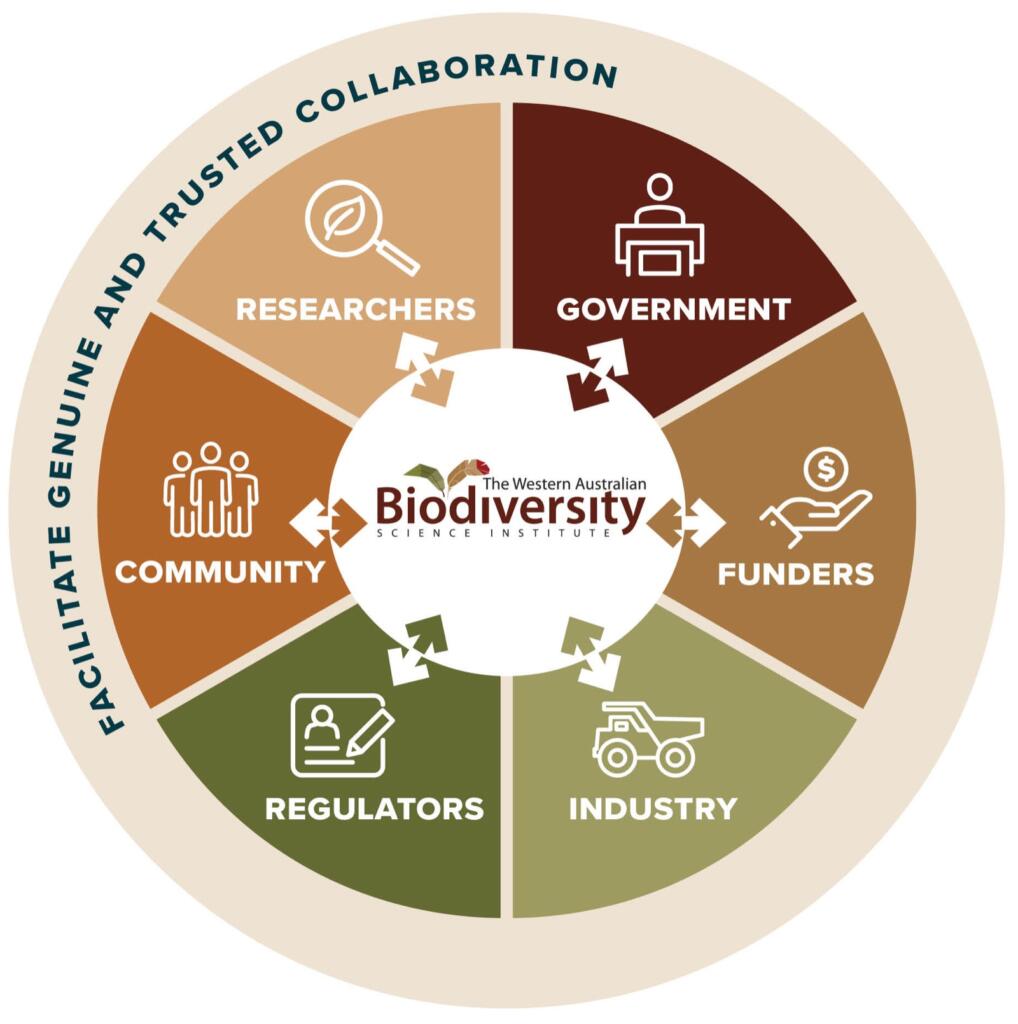
Diagram: the WABSI logo at the centre of a ring of six groups (Researchers, Government, Funders, Industry, Regulators and Community) under the words Facilitate genuine and trusted collaboration

A 2-year consultation, driven by the Government of Western Australia, with industry, government and community organisations, revealed several key findings – duplication of research effort in the State, fragmented, complex and inaccessible environmental information and critical gaps in knowledge still existed, hampering informed decisions about the environment.

In short, the knowledge that end users needed for decisions was either not generated or was not accessible. There was a clear need for collaboration, to guide research effort to meet end user needs.

A decision was made to establish an independent organisation that could lead research collaboration and build a clear pathway for scientific knowledge to reach the people who needed it to make decisions.

Joint venture partnership
WABSI is a partnership with leading Western Australian science research organisations, allowing access to multi-disciplinary research expertise.
Support from multiple sectors
The Government of Western Australia provides core funding for WABSI through the Department of Energy and Economic Diversification, supported by investment from industry, philanthropy and the community.
  1. 2015-2016

    WABSI established

    WABSI established

    WABSI was officially launched in October 2015, with funding from the Western Australian Government through the Department of Jobs, Tourism, Science and Innovation. The late Professor Mick Poole was appointed as inaugural Board Chair, along with The University of Western Australia, as the host institution, to provide corporate support services.

    Over the next twelve months, a governance structure was put in place by the Participant Council which comprised WABSI’s research partner organisations. They established the WABSI Board to guide strategy and operations and the Collaboration, Leverage and Integration Committee to guide targeted research development for meeting end user needs.

    Key executive appointments were made during this period, including inaugural Chief Executive Officer Peter Zurzolo, Communications Manager Preeti Castle, and Program Leads Ashley Sparrow, Lesley Gibson, Guy Boggs and Chris Gentle.

  2. 2017-2018

    The first research program

    Strategic roadmap and the first research program

    In its early establishment phase, WABSI began connecting with biodiversity science end users across government, regulators, industry and community to better understand knowledge needs and key issues of concern.

    A critical issue to emerge was the high level of uncertainty in subterranean fauna assessments. WABSI brought together, for the first time, representatives from the resources sector and environmental regulators, to identify critical gaps in knowledge and reach clear consensus on key focus areas where research was needed. As a result, WABSI’s first, end user driven program was launched, publishing Shedding new light on the cryptic world of subterranean fauna.

    This targeted program helped define WABSI’s research development process – identify end user need, prioritise focus areas and coordinate targeted delivery with partners and stakeholders.

    Early consultation delivered a distinct WABSI brand, a clear strategic roadmap and its first targeted research program, ensuring knowledge reached decision makers as practical, usable tools.

  3. 2019-2020

    Two more targeted programs

    Two more targeted programs to address biodiversity challenges

    Partners from the mining industry, government and research sectors worked together to develop the Completion Criteria Framework, a robust and scientifically informed framework for developing site-specific completion criteria and associated monitoring for Western Australian post-mining rehabilitation. It was endorsed by the Department of Energy, Mines, Industry Regulation and Safety (now restructured into the Department of Local Government, Industry Regulation and Safety).

    Increasing knowledge to mitigate cat impacts on biodiversity was launched to conserve native species through improved management of cats.

  4. 2021-2022

    A strategic refocus

    A strategic refocus, end user consultation and environmental data sharing

    This was the time to review and refocus our vision and purpose. WABSI unveiled an updated, 10-year Strategic Plan 2022-2032. We also reviewed what was important to end users, undertaking extensive consultation with more than 50 end users across industry, financial services organisations, government, conservation groups, non-profits, scientists and researchers. The consultation identified several large, complex issues as knowledge priorities for the next decade and the findings were captured in the publication Biodiversity Knowledge Priorities: Emerging themes from stakeholder consultation.

    The Addressing Weed Threats to Biodiversity research program was launched, identifying non-native invasive plants as one of the greatest threats to native biological diversity and a significant cost to agriculture in Western Australia.

    WABSI’s efforts in building an environmental data sharing and access culture took a giant leap forward, with the launch of the Guide to a Shared Analytics Framework for the Environment and a proposed concept for a Shared Environmental Analytics Facility, co-designed with end users.

  5. 2023-2024

    Four new programs

    Four new programs build the science to drive the WA economy

    WABSI led development of a state-level investment framework to attract private capital into land restoration, culminating in The Restoration Economy: A roadmap towards a sustainable industry with better environmental outcomes.

    Stakeholder workshops shaped a prioritised research framework tackling biodiversity loss from Perth’s rapid urban growth and climate change, with focus areas published in the Building Biodiversity for Thriving Urban Ecosystems.

    WABSI delivered a world-first milestone as part of BHP’s Technical Advisory Team, contributing to the Beenup Site Pilot Case Study, a natural capital accounting study at BHP’s rehabilitated Beenup Mineral Sands site. It tracked outcomes for nature from mining to restored habitat for threatened species, aligned with UN Sustainable Development Goals.

    Building on 2022 consultations, the Biodiversity Economics and Finance program advanced work on measuring, valuing and financing biodiversity, releasing Assessing Knowledge Gaps in Biodiversity Economics and Finance to guide future research priorities.

  6. 2025-2026

    Scaling restoration

    Scaling restoration and strengthening the evidence base

    WABSI published Scaling up the WA Restoration Economy, setting priorities around valuing restoration benefits, coordinating a state-wide strategy, and building consistent monitoring and reporting approaches. We also delivered the Restoration Standards for the Western Australian Wheatbelt, a practical framework and 5-star recovery system to guide consistent, science-based restoration of the Wheatbelt’s Eucalypt Woodlands, supported by practical factsheets on market-led and regulatory compliance-led restoration pathways.

    Two Northern Jarrah Forest reports were published – Identifying Gaps in Knowledge, Management and Conservation in the Northern Jarrah Forest and Strategic Opportunities for Environmental Offsets in the Northern Jarrah Forest, developed under the South West Sustainability Partnership.

    Advancing work on biodiversity economics and finance, WABSI published Nature on the Balance Sheet, a prioritised research program built on economics, value and measurement developed through extensive stakeholder and Traditional Owner consultation.

    Navigating Knowledge Gaps for Western Australian Inland Waters was launched; a program focusing on research priorities to enable biodiversity resilience of inland aquatic ecosystems.

    A fresh round of end-user consultations underpinned From Knowledge to Action: Western Australia’s Biodiversity Knowledge Priorities, refreshing the priorities first set in 2022. A plain language guide Nature’s Big Questions made concepts around biodiversity science and evidence based decision-making more accessible to broader audiences across education, policy and community.
The next decade

Addressing emerging issues, targeting knowledge gaps.

WABSI continues to consult on a regular basis with biodiversity science end users to unpack complex issues, both current and emerging, which in turn help develop targeted research programs.