
Biodiversity economics & finance
Connecting biodiversity science, economics and finance to improve decisions, manage nature-related risk and unlock sustainable investment opportunities.
Understanding biodiversity’s economic value
Nature underpins economic activity, community wellbeing and the resilience of natural systems, yet biodiversity value, dependencies and risks are not consistently incorporated into economic and investment decisions.
WABSI’s Biodiversity Economics & Finance Program starts with the needs of businesses, governments, investors and other decision-makers seeking to understand and manage these issues. Through consultation, the program identifies critical knowledge gaps and develops a prioritised research agenda to address them.
Research explores how biodiversity can be understood in economic terms, how nature-related risks and dependencies can be identified, and how evidence can inform investment and financial decisions.
The program connects independent science with economics, finance, policy and industry practice, translating research into practical evidence and tools. Its purpose is not simply to quantify nature, but to improve decisions that affect biodiversity and the economy, while identifying opportunities for investment that support sustainable and nature-positive outcomes.
- Natural capital
- The stocks of natural resources and ecosystems that generate benefits and services supporting people, economies and wellbeing.
- Nature-related risk
- Economic and financial risks arising from dependencies and impacts on nature, including biodiversity and ecosystem services.
- Nature-positive investment
- Investment that contributes to halting and reversing biodiversity loss while supporting resilient economic activity.

Economic decisions increasingly need to account for biodiversity, but decision-makers often lack the evidence, methods and information needed to understand nature-related value, dependencies, risks and opportunities.
Biodiversity is fundamental to productive landscapes, resource development, infrastructure, agriculture, communities and many other parts of the economy. Yet conventional economic and financial decisions can overlook the value of ecosystems and the risks associated with biodiversity decline.
This creates uncertainty for businesses, governments and investors seeking to manage environmental dependencies, assess exposure to nature-related risks or identify opportunities for positive outcomes.
Western Australia also needs to translate developments in natural capital accounting, disclosure and nature-positive finance into approaches relevant to local industries, ecosystems and policy settings.
End users need evidence that is credible, practical and proportionate to the decisions they face. WABSI responds by identifying priority knowledge gaps and coordinating research that connects biodiversity science with economics and finance.
The program explores how biodiversity values can be better understood, how risks and dependencies can be incorporated into decisions, and where investment can support measurable biodiversity outcomes.
This creates a pathway from scientific evidence to economic decisions, strengthening sustainable growth while improving outcomes for nature.


Where the program focuses.
The research agenda focuses on the evidence needed to make biodiversity more visible in economic decisions and identify practical pathways for managing risk and supporting investment.
-
Economics
Understanding how biodiversity underpins the economy and human well-being helps show what its loss costs us, and why it should be built into economic and financial decisions.
-
Value
Understanding the many ways nature is valuable to us, from things with a market price to cultural and spiritual meaning, and how those values can be measured in different settings and industries.
-
Measure
Better ways to measure and track biodiversity, using consistent, reliable methods and indicators, and sharing that information openly.

WABSI begins with the decisions end users need to make and the information they need to make them confidently.
The program brings together biodiversity scientists, economists, finance specialists, government, industry and investors to identify priority knowledge gaps and coordinate research around shared needs.
Research is designed to be relevant to Western Australia’s environmental and economic context while connecting with national and international developments. Independent science provides the evidence base, while collaboration with end users helps translate findings into approaches that can be applied in policy, business strategy, risk management and investment.
The program recognises that biodiversity and economic outcomes are interconnected. By examining both, WABSI helps identify where better knowledge can reduce uncertainty, strengthen resilience and create new opportunities.
The result is a clearer pathway from biodiversity science to economic decision-making and measurable outcomes.
What the program aims to achieve.
Make biodiversity economically visible
Develop evidence that helps decision-makers understand biodiversity’s value, dependencies, risks and contribution to economic resilience.
Support nature-related risk decisions
Improve evidence available to businesses, government and investors managing risks associated with biodiversity loss and ecosystem change.
Enable better investment
Identify opportunities and evidence requirements for investment that can deliver measurable biodiversity and economic outcomes.
Connect science and finance
Bring biodiversity science, economics and finance together to support practical and credible decision-making.
Outputs from the program.
-
 01
Nature on the balance sheet
2025 Download PDF -
 02
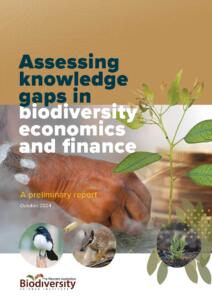
Assessing knowledge gaps in biodiversity economics and finance
2024 Download PDF
Other WABSI
research programs.


Help close the knowledge gaps that matter.
Nature-positive economic decision-making requires collaboration between science, business, government and finance. WABSI provides a platform for organisations to identify shared information needs, shape research priorities and connect independent biodiversity science with economic and investment decisions.
Businesses can help define questions that matter for strategy and risk; government can align research with policy and public value; researchers can contribute scientific and economic expertise; and investors can identify evidence needed for credible opportunities.
Together, these perspectives can build a stronger evidence base for sustainable growth and measurable biodiversity outcomes.
-
Industry and business
Help identify biodiversity-related dependencies, risks and information needs, and collaborate on research that can strengthen strategy, resilience and environmental performance.
-
Government and policy
Work with WABSI to develop evidence that supports natural capital, biodiversity policy, sustainable development and public investment decisions.
-
Finance and investment
Identify evidence requirements for assessing nature-related risk and opportunities and help shape research that supports credible biodiversity investment.
-
Researchers
Connect biodiversity science with economics and finance to develop research that can influence real-world decisions and investment.
- Direct email info@wabsi.org.au